Sunday, 3 June 2012

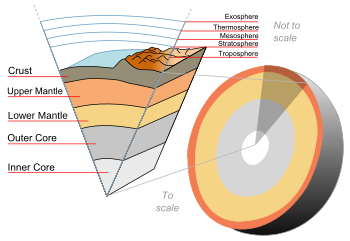
The Inner Core

The Inner Core is one of five sections of the Earth's Core that is the centre part.It was discovered in 1936
by seismologist Inge Lehmann.

It is thought to consist of iron-nickel alloy and may have a temperature similar to that of the Sun's surface, approximately 5430 C (5700 K).  It is surrounded by thick layers of outer core, mantle, upper mantle and crust.

A man named J.A Jacobs was the first person to have a theory of the fact that the inner core was freezing and growing out of liquid outer core due to the gradual cooling of Earth's interior, which is about 100 degrees Celsius per billion years. It's innermost hottest part as detected by seismological studies, is a primarily solid ball approximately 1,220 km in radius or 70% of that of the moon.

The outer core is surrounded by a thick layer of mantle, which in some places under the ocean is actually exposed on the surface of the Earth.

Saturday, 2 June 2012

1987a Supernova

1987a Supernova (also known as SN 1987a) is a supernova system on the edge of the Tarantula Nebula in the Large Magellanic Cloud. It is approximately 5.4 kiloparsecs from Earth (167,885 light years)

As it's name suggests, it was discovered in 1987 by Ian Shelton and Oscar Duhalde in the Las Campanas Observatory in Chile. On March 4th 1987 it was observed by the largest ultraviolet space telescope of that time, named Astron.

It is located in the constellation Dorado with a right ascension of 05h 35m 28.03s and it is the closest recorded supernova since the invention of telescopes.It is close enough to be visible to the naked eye but still outrageously far away. It is the closest observed supernova since SN 1604, which actually occurs in the Milky Way.

The "A" in the name comes from the fact that it was the first supernova discovered in 1987. The progenitor type is B3 supergiant,which has surface temperatures of 30,000-50,000 K


Cygnus X-1 Black Hole


The Cygnus X-1 Black Hole is a black hole system that is one of the strongest X-ray sources seen from Earth in the constellation Cygnus discovered in 1964 and was the subject of physicists Stephen Hawking and Kip Thorne.


It's age is approximately 5 million years old with a with a radial velocity of -13km/s and a right ascension of 19h 58m 21.67595s. It's mass is 14-16 and a radius of 20-22.It was discovered during a 1964 rocket flight.

The largest star in the Cygnus OB3 association has a mass 40 times that of the Sun. The Cygnus X-1 system shares a common motion through space with an association of massive stars named Cygnus OB3, located at approximately 2,000 parsecs from the Sun.Like all black holes, it is invisible and it's job in space is to suck in dead stars. In Star Trek, it is used by villains to destroy a planet they don't want.

It's variable type is ellipsoidal variable, also known as variable star.There is two types of variable star:


  • Intrinsic variables, whose luminosity changes
  • Extinsic variables, whose apparent changes in brightness are due to changes in the amount of their light that can reach Earth.


Friday, 28 October 2011

Neptune


Neptune is the furthest planet from the Sun which also makes it the coldest.

There are many large storms on Neptune, one of which is called the Great Dark Spot, 609px-Neptunewhich resembled the Great Red Spot on Jupiter. You will see more information about this storm on post Jupiter.

It was named after the Roman god of the sea, Neptune, because it has got so many dark seas and storms.

It was discovered by the astronomers Urbain Le Verrier, Johann Galle and John Couch Adams.

Geysers have been observed on Neptune’s largest moon, Triton, which can also be found on Earth and also signs of carbon dioxide eruptions on the the southern polar cap of Mars

Tuesday, 25 October 2011

Uranus


600px-Uranus2Uranus spins on its side because it was knocked over by an object billions of years ago.

It was discovered by William Herschel in March 13, 1781.

The speed of the wind on Uranus can reach 250 metres per second (560 mph)

The temperature of Uranus can go up to –371 Fahrenheit or -224 Centigrade.

The sunlight on Uranus is only 1/400th as strong as it is on Earth.

Sunday, 18 September 2011

Saturn


saturnSaturn is the second largest planet in the solar system.

A huge hexagonal whirlwind spins non-stop around Saturn. Four earths could fit inside it.

The rings of Saturn are the most visible of all the planets. Although if you tried to see them with a naked eye, they would almost appear invisible!

Saturn has the least density of all the planets, it is the only one that would float on water.

Titan, Saturn’s largest moon, is the second largest moon in the solar system after the Galilean moon Ganymede.

Tuesday, 13 September 2011

HD85512B


This is about the newly discovered planet called HD85512B.

Scientists think they have discovered a new planet that is just about suitable to have life on it. It is more often called “Goldilocks Planet” because it is just right. They have recorded it being 50 centigrade, almost hot as the 57 Celsius recorded in El Azizia in Libya. (The hottest temperature recorded on Earth).

u3m9w7Vp35xjfqH0If you look carefully at this picture it looks comparable to Earth.

It was discovered on the 17th August 2011 by the European Southern Observatory in La Silla. Chile.