Saturday, 11 May 2013
Sharks
The largest shark (and fish) in the sea is the whale shark. It diets on small fish, krill, plankton and small invertebrates.
The fiercest is the great white shark. It diets on large fish such as tuna, rays, other sharks and very, very rarely humans.
The smallest shark is the dwarf lanternshark. Scientists have not studied it close enough to find out about their diet.
Saturday, 14 July 2012
Hoba Meteorite
It is in fact 16% nickel and 84% iron, and thought to be discovered by a farmer while ploughing a field in 1920, but it was thought to of actually fell 80,000 years ago.
It's biological classification is ataxite, a type of iron. Ataxite is consisted of taenite, plessite and troilite. Iron hydroxides are on the back and was named after the farm it was found on, called Hoba West.
Tuesday, 5 June 2012
Kepler 22b
It has a temperature of 262 K and is the first transiting planet to orbit within the habitable zone of a Sun-like star. It's discoverers are the Kepler science team when they looked through their space telescope and, according to science, is larger than Earth and it's star (Kepler 22) is thought to be only slightly smaller than the Sun.
The name "B" in it is because the star was discovered before it so it is named B, very much like the naming of the 1987a supernova. It's right ascension is 19h 16m 52.2s.It is the first extrasolar planet confirmed by Kepler to orbit within it's star's habitable zone.
It's radius is roughly 2.4 times that of Earth's radius but it's mass and surface composition remain still unknown.There is a real theory that the planet is "ocean-like" and similar to another planet, Gliese 1214b.
Sunday, 3 June 2012
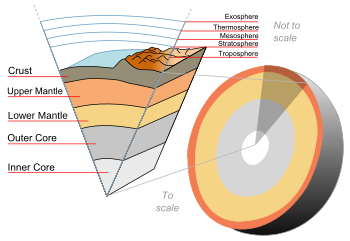
The Inner Core
by seismologist Inge Lehmann.
It is thought to consist of iron-nickel alloy and may have a temperature similar to that of the Sun's surface, approximately 5430 C (5700 K). It is surrounded by thick layers of outer core, mantle, upper mantle and crust.
A man named J.A Jacobs was the first person to have a theory of the fact that the inner core was freezing and growing out of liquid outer core due to the gradual cooling of Earth's interior, which is about 100 degrees Celsius per billion years. It's innermost hottest part as detected by seismological studies, is a primarily solid ball approximately 1,220 km in radius or 70% of that of the moon.
The outer core is surrounded by a thick layer of mantle, which in some places under the ocean is actually exposed on the surface of the Earth.
Saturday, 2 June 2012
1987a Supernova
As it's name suggests, it was discovered in 1987 by Ian Shelton and Oscar Duhalde in the Las Campanas Observatory in Chile. On March 4th 1987 it was observed by the largest ultraviolet space telescope of that time, named Astron.
Cygnus X-1 Black Hole
- Intrinsic variables, whose luminosity changes
- Extinsic variables, whose apparent changes in brightness are due to changes in the amount of their light that can reach Earth.
Friday, 28 October 2011
Neptune
Neptune is the furthest planet from the Sun which also makes it the coldest.
There are many large storms on Neptune, one of which is called the Great Dark Spot, which resembled the Great Red Spot on Jupiter. You will see more information about this storm on post Jupiter.
It was named after the Roman god of the sea, Neptune, because it has got so many dark seas and storms.
It was discovered by the astronomers Urbain Le Verrier, Johann Galle and John Couch Adams.
Geysers have been observed on Neptune’s largest moon, Triton, which can also be found on Earth and also signs of carbon dioxide eruptions on the the southern polar cap of Mars
Tuesday, 25 October 2011
Uranus
Uranus spins on its side because it was knocked over by an object billions of years ago.
It was discovered by William Herschel in March 13, 1781.
The speed of the wind on Uranus can reach 250 metres per second (560 mph)
The temperature of Uranus can go up to –371 Fahrenheit or -224 Centigrade.
The sunlight on Uranus is only 1/400th as strong as it is on Earth.
Sunday, 18 September 2011
Saturn
Saturn is the second largest planet in the solar system.
A huge hexagonal whirlwind spins non-stop around Saturn. Four earths could fit inside it.
The rings of Saturn are the most visible of all the planets. Although if you tried to see them with a naked eye, they would almost appear invisible!
Saturn has the least density of all the planets, it is the only one that would float on water.
Titan, Saturn’s largest moon, is the second largest moon in the solar system after the Galilean moon Ganymede.
Tuesday, 13 September 2011
HD85512B
This is about the newly discovered planet called HD85512B.
Scientists think they have discovered a new planet that is just about suitable to have life on it. It is more often called “Goldilocks Planet” because it is just right. They have recorded it being 50 centigrade, almost hot as the 57 Celsius recorded in El Azizia in Libya. (The hottest temperature recorded on Earth).
If you look carefully at this picture it looks comparable to Earth.
It was discovered on the 17th August 2011 by the European Southern Observatory in La Silla. Chile.
Tuesday, 30 August 2011
Jupiter
Jupiter is the largest planet in the solar system.
Because the orbit of Jupiter is outside the Earth's, the phase angle of Jupiter as viewed from the Earth never exceeds 11.5°.
Jupiter has the fastest orbit of all the planets, just 10 Earth hours to complete a whole run.
A huge violent hurricane blows non-stop around Jupiter called the Great Red Spot. Three or four Earths could fit inside it.
The Galilean Moons are the biggest moons on Jupiter, discovered by astronomer Galileo Galilei, which includes Io, Callisto, Europa and Ganymede. Ganymede is the largest moon in the solar system, even bigger than the planet Mercury.
Wednesday, 24 August 2011
Mars
Mars has the biggest volcano in the solar system called Olympus Mons, it is about 17 miles high.
A dried up gorge runs across one side of Mars called Valles Marineris. It stretches for more than 4,000km (2,500 miles). It would stretch all the way across Europe.
Mars is named after the Roman god of war because of Mars’ blood red colour.
On Mars, days are quite similar, one Mars day is 25 Earth hours, only one more hour than our day.
Mars’ moons, Phobos and Deimos, are irregularly shaped.
Monday, 22 August 2011
Earth
Earth is the largest of the four rocky planets.
Earth is the only planet we know with life on it. With its many oceans, lakes, rivers and ponds, two thirds of Earth are actually just water.
Sputnik 2, first satellite to observe and measure conditions in space, actually had a dog on board.
Wrapped around Earth is a layer of gases and water vapour, called atmosphere. The atmosphere allows us to breathe. It also protects us from dangerous sun rays.
Earth is the only planet that we know that we can breathe on.
Venus
Venus is the hottest planet in the solar system. All Venus days long the average temperature is 465 degrees celsius. That is equal to 870 degrees farenheight!
You wouldn’t survive on Venus for one second. You would be crushed by the pressurized atmosphere, poisoned by deadly gases and fried by the ferocious heat.
On Venus, you may find some flat, rounded volcanoes known as “pancake domes”. They formed from thick, slow-moving lava that became solid before it could flow very far.
Venus is known as Earth’s “sister planet” because it has quite a few similarities. For example, it is about the same size.
Venus is named after the Roman goddess of love and beauty because Venus is so bright and beautiful.
Friday, 19 August 2011
Mercury
Mercury is the smallest planet in the Solar System.
The biggest temperature differences are on Mercury. At night it is freezing, as low as -185 degrees celsius. However, in the day time it is boiling. At up to 425 degrees celsius.
Mercury takes only 88 Earth days to orbit the Sun, making a year short. However, one day on Mercury would be 176 Earth days!!
On Mercury you would only weigh 12 kilograms.
Mercury is named after the Roman messenger god because the planet moves so quickly across the sky.
The Sun
The official definition of a star like The Sun is a "Yellow G2 Dwarf." It is an average, middle-aged star.
Every bit of wood, coal and oil in the world would only keep the Sun burning for a fraction of a second.
The Sun's gravitational pull is so strong that, even a dwarf planet 5,900,000,000 kilometres away from it (Pluto) is still kept in orbit of the Sun. There are more dwarf planets even further away than Pluto which are kept in orbit by the Sun.
If you could take a journey in an normal airliner flying at its normal speed (about 644 km an hour) travelling from Earth to the Sun, it would take 20 years to reach your destination, and that's without stopping.
If the Sun was brighter, it would be hotter and would have burnt off its hydrogen fuel billions of years ago. This means that, if the Sun is any different to how it is now, life on Earth would not exist. It is the perfect size, perfect age, perfect distance, perfect temperature and perfect brightness for life to exist on a planet like Earth.
Different Alphabets
English
A, B, C, D, E, F, G, H, I, J, K, L, M, N, O, P, Q, R, S, T, U, V, W, X, Y, Z
Greek
Alpha, Beta, Gamma, Delta, Epsilon, Zeta, Eta, Theta, Iota, Kappa, Lambda, Mu, Nu, Xi, Omicron, Pi, Rho, Sigma, Tau, Upsilon, Phi, Chi, Psi, Omega
Phonetic
Alpha, Bravo, Charlie, Delta, Echo, Foxtrot, Golf, Hotel, India, Juliet, Kilo, Lima, Mike, November, Oscar, Papa, Quebec, Romeo, Sierra, Tango, Uniform, Victor, Whisky, X-Ray, Yankee, Zulu
Thursday, 18 August 2011
Location of TIMEGLASS Labs
The TIMEGLASS Labs are just on the left of London Bridge.They are going to be somewhere near, or possibly next to, Tower Bridge. You can see lots of buildings from the top window and will become the tallest in London beating the 310m (1,020 ft.) Shard London Bridge at 330m (1,082ft.)
Tuesday, 16 August 2011
My Mnemonic for Planets
Very (Venus)
Early (Earth)
Morning (Mars)
Jousting (Jupiter)
Sitting (Saturn)
Under (Uranus)
Nine (Neptune)
Potatoes (Pluto)